CRYOGENIC SEMI RIGID CABLES





In cryogenic systems, the coaxial cable serves not only as a signal carrier but also as a thermal bridge. This page helps you quickly identify materials and semi-rigid cable types—from stainless steel to CuNi and NbTi.
Anyone planning a system for low temperatures knows that the biggest challenge is often not the signal itself, but the heat input through the cables.
A cryogenic semi-rigid cable must therefore meet two conflicting requirements:
- the lowest possible thermal conductivity
- while maintaining sufficient electrical performance
The choice of the right material determines the heat load, attenuation, mechanical stability, and operational reliability.
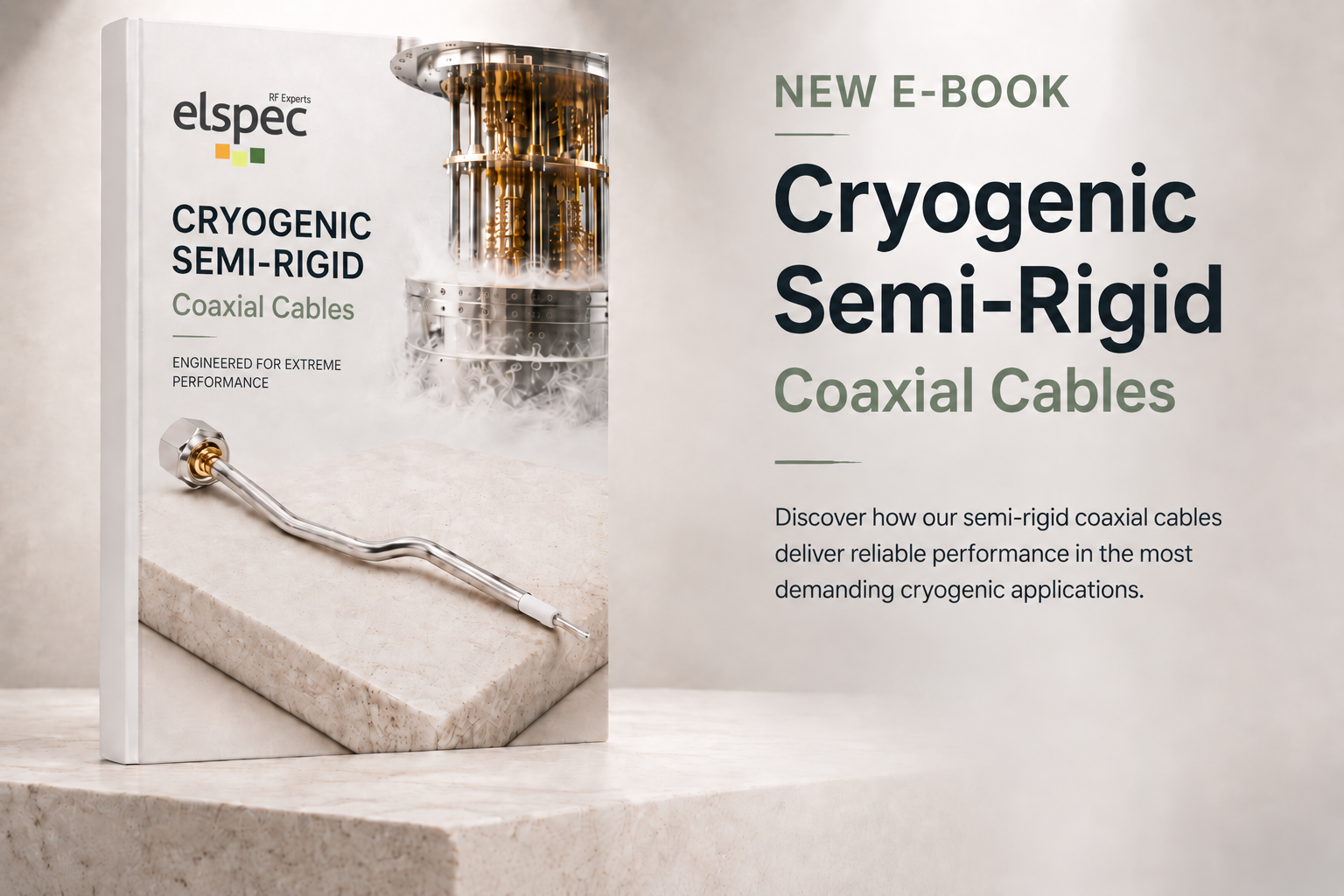
Have you discovered our new E-BOOK yet?
Cryogenic applications place the highest demands on RF cables. Our e-book “Cryogenic Semi-Rigid Coaxial Cables” provides a compact overview of the materials and key properties required for reliable connections at extremely low temperatures.
Ideal for Quantum Computing, Research & Development, and Test & Measurement.
Structure
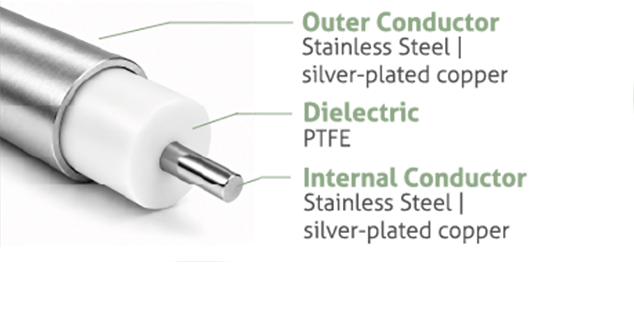
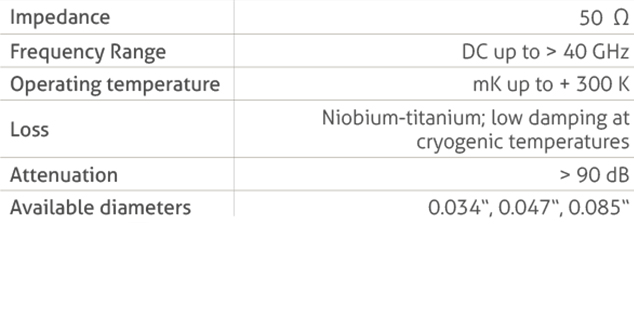
Feature
Which Cryogenic Semi Rigid Cable is The Right Choice?
- Stainless steel Semi Rigid: Applications where heat input is more important than minimal attenuation
- NbTi Semi Rigid: Highly sensitive applications, with a focus on minimal heat input and the lowest possible attenuation
- SS-SSSP Semi Rigid: For high-frequency applications where the skin effect can be utilized
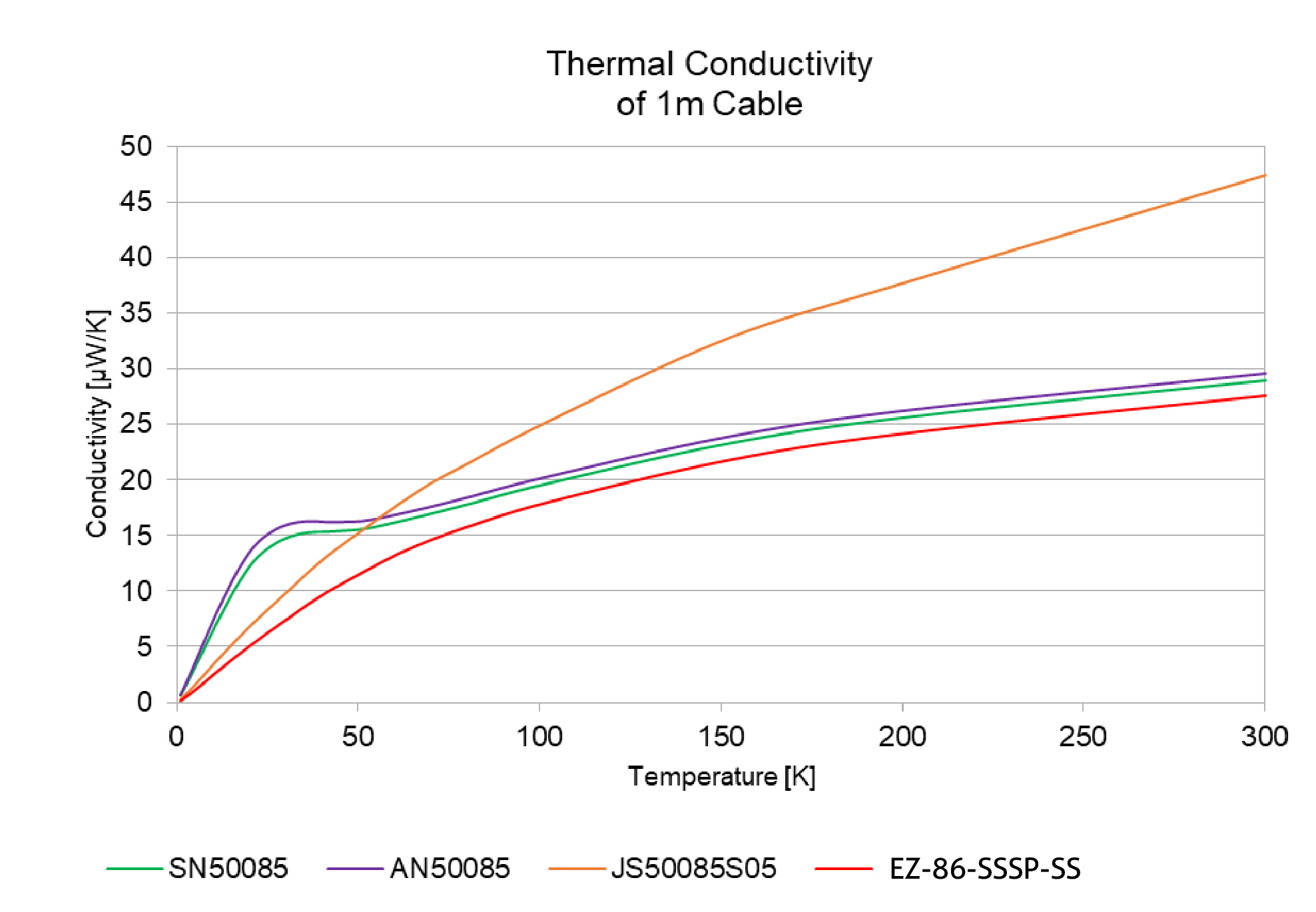
Which cryogenic semi-rigid cable is right for your application?
Selecting a cryogenic coaxial cable always involves balancing attenuation, thermal load, installation space, and signal integrity. The following table provides an initial guide to typical cable types for applications ranging from high-density integration to critical signal paths in the millikelvin range.
Product Variants
| Description | Order No. | Outer Diameter | Dielectric Mat. | Material Inner Conductor | Material Outer Conductor |
|---|---|---|---|---|---|
| AN50085/UT085-CUSS | 14481 | 2.20 | Low-density PTFE | Silver-plated Copper | Copper Lined Stainless Steel |
| EZ-86-NBTI | 23033 | 2.18 | PTFE | NbTi | NbTi |
| EZ-47-SS-SS | 23054 | 1.19 | PTFE | Stainless Steel | Stainless Steel |
| EZ-86-SSP-SS | 23218 | 2.18 | PTFE | Silver-plated 304 Stainless Steel | Stainless Steel |
| EZ-86-SS-SS | 23349 | 2.18 | PTFE | Stainless Steel | Stainless Steel |
| EZ-34-SS-SS | 23355 | 0.86 | PTFE | Stainless Steel | Stainless Steel |
FAQs
Flexible Coaxial Cables feature a flexible outer conductor made of metallic braid (StCuAg or CuAg) and foil structures.
The dielectric consists of FEP or PTFE materials. These cables allow flexible routing and are particularly suitable for applications involving repeated movement.
The smallest outer diameter is 0.8 mm.
Semi-Rigid Coaxial Cables feature a solid, tubular metallic outer conductor made of stainless steel or copper.
The outer conductor ensures consistent cable geometry, resulting in a tightly controlled characteristic impedance.
The smallest outer diameter of semi-rigid coaxial cables is 0.51 mm.
Yes, absolutely. We supply both bulk cable and fully customized, ready-to-use cable assemblies.
- Suitable connectors: Assembled with cryogenic or non-magnetic connectors (e.g. SMA, 2.92 mm, SMP).
- Tested quality: Individual test reports for attenuation and return loss (VSWR) are available upon request.
- Bundle options: Also available as multi-channel cable bundles, including non-magnetic versions with low thermal conductivity.
Recommended Cleaning Procedure for Vacuum Applications
1. Initial Cleaning
Remove dust and particles using oil-free compressed air or dry nitrogen.
Then clean the cable with lint-free wipes.
2. Degreasing
Clean with high-purity isopropyl alcohol (IPA, 99.9%) or acetone, provided that all materials used are compatible with the solvent.
Do not use cleaning agents containing oils, silicones, or other substances that may leave residues.
3. Fine Cleaning
Perform a final cleaning using fresh lint-free wipes and clean solvent.
Wear powder-free nitrile gloves during cleaning to prevent fingerprints and contamination.
4. Drying
Allow the cable to dry completely in air or use dry nitrogen.
No solvent residue should remain on the cable.
5. Optional Bake-Out
For high-vacuum or ultra-high-vacuum (UHV) applications, a bake-out at 100°C to 150°C may be appropriate, provided that the cable and connector materials are approved for these temperatures.
Additional Recommendations for Ultra-High Vacuum (UHV)
- Avoid direct skin contact after cleaning.
- Fit cleaned cables with protective caps and package them in a particle-free environment until installation.
- For extended storage, keep cables in a clean and dry environment.
- Avoid oil-based products, silicone-containing lubricants, and contaminated compressed air.
Material Considerations
For vacuum and UHV applications, we recommend cable constructions using low-outgassing materials such as PTFE, FEP, or PFA insulation, combined with vacuum-compatible connectors. Materials with high outgassing characteristics, such as PVC or unsuitable plasticizers, should be avoided.
Important Notice:
Final approval for use in your vacuum system remains the responsibility of the system operator, as acceptable cleanliness requirements may vary depending on the vacuum level and process. We therefore recommend performing all cleaning and qualification procedures in accordance with your internal vacuum and UHV guidelines.
- Bulk lengths / straight lengths:
- Semi-rigid cables are typically supplied in standard straight lengths from 1.525 m to 3.05 m (5 to 10 feet). Coils of up to 50 ft are also available upon request.
- Flexible and hand-formable versions are also available on reels in longer continuous lengths.
- Cable assemblies: Custom cable assemblies are manufactured to your exact length specifications, ranging from 25 mm to 15 metres.
Yes. For magnetic-field-sensitive environments (such as quantum computing, MRI systems, or high-precision research magnets), we offer specially certified non-magnetic cables and connectors:
- Materials: Bare copper, silver-plated copper, tin-plated copper
Not sure yet which cryogenic cable is the right choice for your setup?
During our technical consultation, we help you identify the solution that best matches your frequency range, thermal requirements, and mechanical specifications.